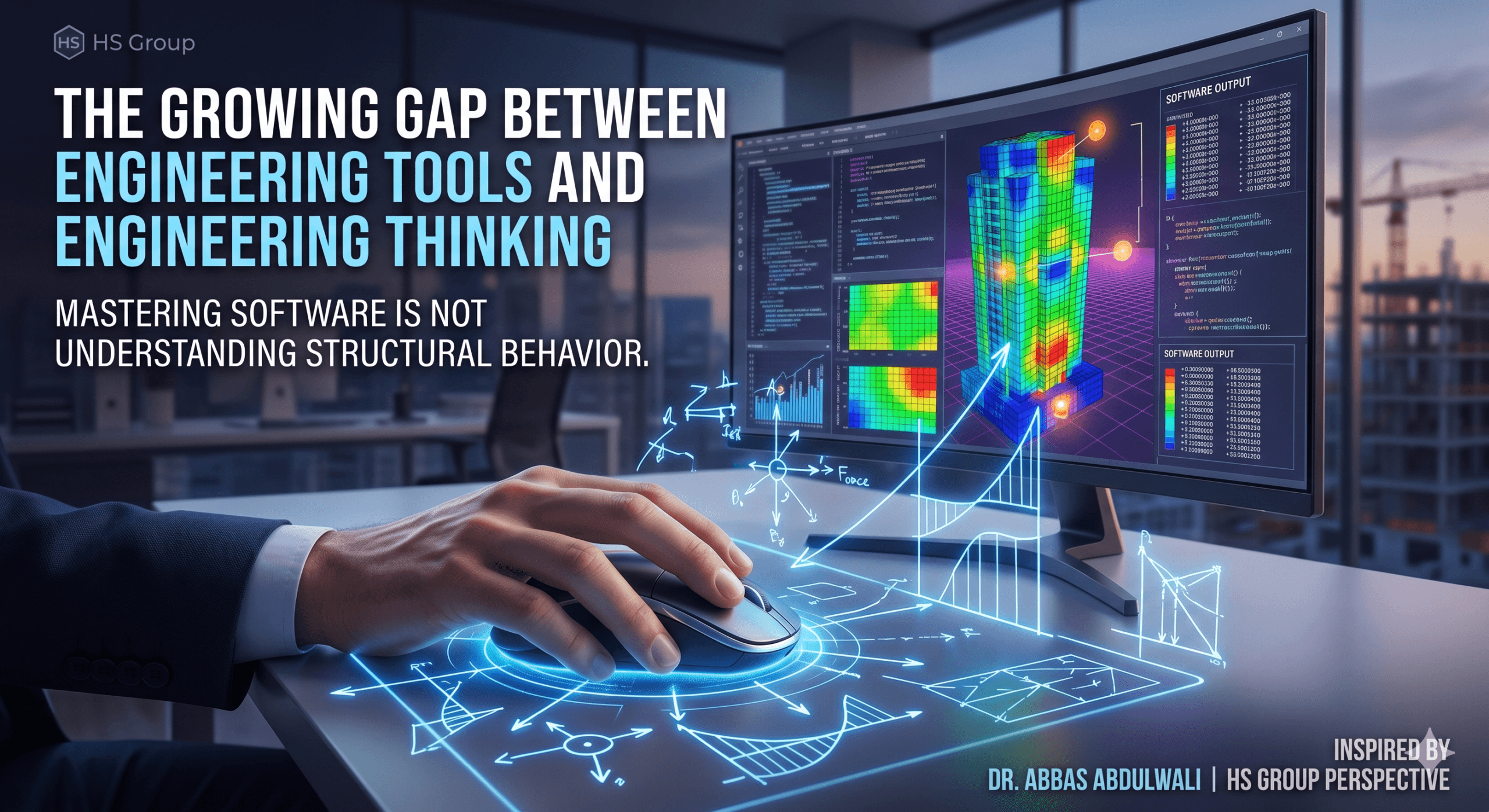
The Growing Gap Between Engineering Tools and Engineering Thinking
The construction industry has witnessed remarkable technological advancements over the past decades. From manual calculations and slide rules to sophisticated digital modeling platforms and artificial intelligence, engineers now have access to powerful tools capable of producing results within seconds.
Yet, this rapid evolution has introduced a new challenge: the widening gap between mastering software and understanding the engineering principles behind it.
At HS Group, we believe that technology should enhance engineering expertise—not replace it.
The Rise of “Black Box Engineering”
Modern software solutions such as ETABS, SAP2000, Revit, and other advanced analysis tools have transformed the design process. However, an increasing number of professionals rely heavily on software outputs without fully understanding the structural behavior and physical principles governing those results.
This phenomenon, often referred to as “Black Box Engineering,” occurs when engineers trust computer-generated outputs without critically evaluating whether those results make engineering sense.
While digital tools improve efficiency, they cannot replace engineering judgment.
Why Engineering Fundamentals Still Matter
Engineering is not merely about generating colorful reports or running simulations. It is fundamentally about understanding how structures behave, how loads travel, and how forces interact with materials.
Without this understanding, several risks emerge:
- Overdesigned and uneconomical structures.
- Failure to detect modeling errors.
- Reduced ability to solve site problems.
- Blind trust in numerical outputs.
- Increased safety risks and reduced innovation.
Software can calculate, but only engineers can interpret.
Technology Should Support, Not Replace, Engineering Judgment
Experienced engineers do not accept software results blindly. Instead, they perform quick hand checks and conceptual evaluations to ensure that outputs align with expected structural behavior.
A reliable engineering workflow typically includes:
1. Understanding Structural Behavior Before Modeling
Before opening any software, engineers should visualize load paths and estimate forces conceptually. Preliminary calculations remain an essential step in validating computer-generated results.
2. Understanding the Philosophy Behind the Software
Knowing how finite element analysis works is more valuable than simply learning where to click. Understanding assumptions, boundary conditions, and modeling limitations is critical for producing reliable designs.
3. Performing Independent Verification
Random checks on beams, columns, and load distributions provide confidence in the accuracy of the model and help identify potential errors before construction begins.
4. Reading Structural Behavior Instead of Numbers
Deflection shapes, moment diagrams, stiffness distribution, and load paths often reveal more than reinforcement schedules alone. Structural behavior should always be examined before accepting numerical outputs.
5. Maintaining Strong Connections with Construction Reality
Engineering does not end at the computer screen. Site experience bridges the gap between theoretical models and practical execution, ensuring that designs remain both safe and buildable.
Developing the Next Generation of Engineers
Closing the gap between tools and principles requires more than software training. It requires mentorship, practical exposure, and a renewed emphasis on engineering fundamentals.
Young engineers should strive to move beyond being data operators and become problem solvers capable of combining analytical thinking with technological capabilities.
The HS Group Perspective
At HS Group, we view technology as a powerful enabler—but never a substitute for engineering knowledge.
Advanced software, digital workflows, and AI-driven solutions can significantly improve productivity and precision. However, true engineering excellence lies in the ability to question results, understand structural behavior, and apply sound engineering principles.
Because ultimately, software serves engineering—not the other way around.
Author’s Inspiration: Dr. Abbas Abdulwali
The Growing Gap Between Engineering Tools and Engineering Thinking
The construction industry has witnessed remarkable technological advancements over the past decades. From manual calculations and slide rules to sophisticated digital modeling platforms and artificial intelligence, engineers now have access to powerful tools capable of producing results within seconds.
Yet, this rapid evolution has introduced a new challenge: the widening gap between mastering software and understanding the engineering principles behind it.
At HS Group, we believe that technology should enhance engineering expertise—not replace it.
The Rise of “Black Box Engineering”
Modern software solutions such as ETABS, SAP2000, Revit, and other advanced analysis tools have transformed the design process. However, an increasing number of professionals rely heavily on software outputs without fully understanding the structural behavior and physical principles governing those results.
This phenomenon, often referred to as “Black Box Engineering,” occurs when engineers trust computer-generated outputs without critically evaluating whether those results make engineering sense.
While digital tools improve efficiency, they cannot replace engineering judgment.
Why Engineering Fundamentals Still Matter
Engineering is not merely about generating colorful reports or running simulations. It is fundamentally about understanding how structures behave, how loads travel, and how forces interact with materials.
Without this understanding, several risks emerge:
- Overdesigned and uneconomical structures.
- Failure to detect modeling errors.
- Reduced ability to solve site problems.
- Blind trust in numerical outputs.
- Increased safety risks and reduced innovation.
Software can calculate, but only engineers can interpret.
Technology Should Support, Not Replace, Engineering Judgment
Experienced engineers do not accept software results blindly. Instead, they perform quick hand checks and conceptual evaluations to ensure that outputs align with expected structural behavior.
A reliable engineering workflow typically includes:
1. Understanding Structural Behavior Before Modeling
Before opening any software, engineers should visualize load paths and estimate forces conceptually. Preliminary calculations remain an essential step in validating computer-generated results.
2. Understanding the Philosophy Behind the Software
Knowing how finite element analysis works is more valuable than simply learning where to click. Understanding assumptions, boundary conditions, and modeling limitations is critical for producing reliable designs.
3. Performing Independent Verification
Random checks on beams, columns, and load distributions provide confidence in the accuracy of the model and help identify potential errors before construction begins.
4. Reading Structural Behavior Instead of Numbers
Deflection shapes, moment diagrams, stiffness distribution, and load paths often reveal more than reinforcement schedules alone. Structural behavior should always be examined before accepting numerical outputs.
5. Maintaining Strong Connections with Construction Reality
Engineering does not end at the computer screen. Site experience bridges the gap between theoretical models and practical execution, ensuring that designs remain both safe and buildable.
Developing the Next Generation of Engineers
Closing the gap between tools and principles requires more than software training. It requires mentorship, practical exposure, and a renewed emphasis on engineering fundamentals.
Young engineers should strive to move beyond being data operators and become problem solvers capable of combining analytical thinking with technological capabilities.
The HS Group Perspective
At HS Group, we view technology as a powerful enabler—but never a substitute for engineering knowledge.
Advanced software, digital workflows, and AI-driven solutions can significantly improve productivity and precision. However, true engineering excellence lies in the ability to question results, understand structural behavior, and apply sound engineering principles.
Because ultimately, software serves engineering—not the other way around.
Author’s Inspiration: Dr. Abbas Abdulwali